
Before you start beekeeping, you need to make sure you have all your essential beekeeping equipment ready – a beehive, protective clothing, a smoker, a hive tool, and a feeder. There are other useful tools, but these basics will be enough to get you started.
Once you have all this, then you are ready to get your bees. As a beginner beekeeper, there are several ways to get bees. Although not the cheapest option, buying a nucleus hive (or a ‘nuc’) is a great way to start. A nuc is just a small temporary hive, usually containing 5 frames with brood (young developing larvae and bees), a working queen, and about 10,000 bees. By transferring this into your beehive, your bees should get off to a great start.
So, if you decide to get a nuc, what is the procedure?
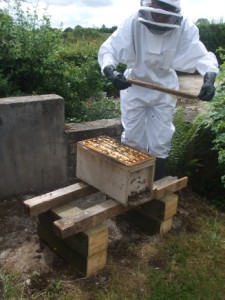
Opening a nuc box
You need to collect your nuc in the evening, when the bees have stopped flying for the day and are all back in the box. The supplier should already have the box sealed using foam or something similar to block the entrance and keep the bees in – you do not want the bees to start flying out of the nuc when it is sitting on the back seat of your car on the way home!
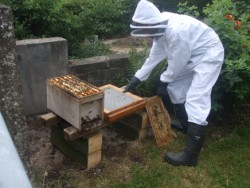
Setting up the new beehive
When you get the nuc home, just place it in the exact spot where you are planning to put your hive and unblock the entrance. Remember to wear protective gear – the bees will mostly stay in the box (as it is still evening time) but the journey may have unsettled them a bit so some will fly out, and may be a little agitated.
Then just leave the bees in their nuc box for a few days and let them get used to their new surroundings. Once they have settled, you need to transfer them from the nuc box into the beehive.
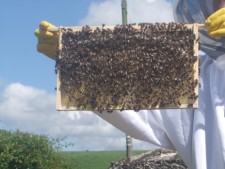
Transferring a frame to the new beehive
Ideally, choose a warm sunny day when the bees are flying well – this way most of the foragers are out gathering nectar and pollen, so there will be fewer bees in the box. Move the nuc slightly to one side, and place your new beehive on the stand where the nuc was. Gently smoke the bees, and open the nuc box (using your hive tool – the lid will probably be well stuck on with propolis). Lift each frame one by one and put them into the hive.
Opinions vary about how best to position the frames in the hive. Some beekeepers keep all 5 frames with brood together, filling out the rest of the brood box with empty frames, others alternate them so you have an empty frame between each full frame of brood. Everyone has their own view, but the truth is that either way will be OK.
Once you have all the frames in the new hive, empty the remaining bees from the nuc box into the hive. If there are a few left in the box, don’t worry. Just leave it at the entrance to the hive and the bees will find their own way in. Put on the crown board, above this an empty super, and the roof.
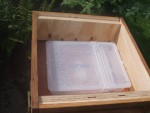
Bee feeder inside a super
To help get your bees of to a good start and encourage them to draw out the foundation, it is a good idea to feed them. If there is a heavy nectar flow in your area, this might not be needed, but it will do no harm. Make up sugar syrup (at a ratio of 1 to 1 sugar to water), put this in your feeder and put the feeder on the crown board (in the empty super). It is best to wait until the evening before feeding, because if you feed syrup when bees are flying you might encourage other bees to rob the hive.
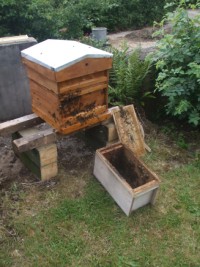
The bees safely in their new hive
And that is it – you are now a beekeeper! The most difficult thing now is to leave the bees alone – it is very tempting to keep opening up the hive to see what is going on! Resist this temptation, just sit back and give your bees a few days to get accustomed to their new home before you do your first inspection.
1 comment
Since this will be my first attempt to start a hive, this is very helpful to me. It has given me a more confident feeling that this is more the bees knowing what to do and my input is simple.
GOD BLESS!!